

Global Synthetic Dyes Market Outlook: Asia-Pacific Textile Industry Drives Growth with BASF, Huntsman & Archroma
Synthetic Dyes Market
Global Synthetic Dyes Market to Surpass USD 14 Billion by 2036 as Regulatory Compliance Restructures Industry Margins
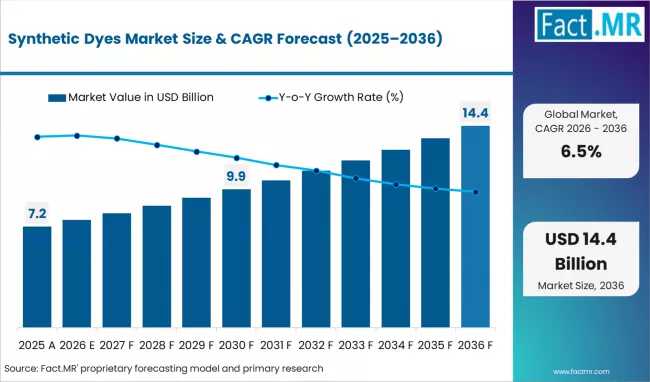
ROCKVILLE, MD, UNITED STATES, April 7, 2026 /EINPresswire.com/ -- The global synthetic dyes market is undergoing a fundamental shift from a cost-driven commodity sector to a regulation-sensitive specialty chemical industry. Valued at USD 7.20 billion in 2025, the market is projected to reach USD 14.39 billion by 2036, expanding at a steady 6.5% CAGR, according to the latest strategic analysis.Market Overview & Strategic Forecast
The industry is entering a decade of ""compliance-led growth."" While expanding textile production in South and Southeast Asia sustains core volumes, the primary value driver is the transition toward eco-compliant formulation chemistry.
For Details Deep insights, Please Request A sample report for Free https://www.factmr.com/connectus/sample?flag=S&rep_id=11751
Current Valuation (2026P): USD 7.67 Billion
Projected Valuation (2036F): USD 14.39 Billion
Incremental Opportunity: USD 6.72 Billion
Key Growth Catalyst: Stringent wastewater discharge regulations and brand-owner mandates for ZDHC MRSL and OEKO-TEX certifications.
Core Market Segmentation (2026 Data)
By Product Type: The Dominance of Reactive Systems
Reactive Dyes command a 58.1% market share. Their ability to form covalent bonds with cellulosic fibers (cotton/viscose) makes them indispensable for the apparel sector, where wash fastness is a non-negotiable metric.
Vat Dyes (20.8%): Essential for the denim and workwear segments due to superior light fastness.
Acid Dyes (15.3%): Pivotal for protein fibers (wool/silk) and synthetic polyamides (nylon).
By End-Use: Textile Primacy
The Textile industry remains the primary engine of demand, accounting for 62.9% of the market.
Pulp & Paper (20.0%): Driven by packaging and specialty tissue requirements.
Leather (10.0%): Focused on high-end upholstery and automotive interiors.
Supply Chain & Pricing Dynamics
The supply chain is currently defined by backward integration. Dye manufacturers who synthesize their own intermediates (such as H-acid and vinyl sulphone) are better insulated from the volatile pricing of raw materials.
Pricing Trends:
Compliance Premiums: Transitioning to low-salt and high-fixation chemistries involves higher synthesis costs, which are increasingly being passed down to textile mills as ""compliance premiums.""
Efficiency Gains: Manufacturers are offsetting costs by offering ""solution packages"" that include process optimization protocols to reduce water and energy consumption.
Competitive Landscape & Key Players
The market is moderately consolidated, with the top 80 players dominating global trade. Huntsman International LLC maintains a leading 12.0% market share, followed closely by other chemical giants.
Prominent Manufacturers:
Global Leaders: Huntsman, BASF SE, LANXESS, Archroma, The Chemours Company.
Regional Powerhouses: Kiri Industries Ltd., Atul Ltd, Shah Industries, KIWA Chemical Industry Co. Ltd.
Regional Analysis: The Ascent of India
Asia-Pacific remains the manufacturing and consumption epicenter.
India (7.5% CAGR): The world’s fastest-growing market, propelled by surging textile exports and domestic capacity expansion in hubs like Surat and Tirupur.
China (7.0% CAGR): Maintains its status as the largest manufacturing base despite rigorous environmental consolidation.
USA & Germany: Focus remains on technical textiles and automotive applications requiring high-performance specialty dyes.
Analyst Perspective
""The margin architecture of the synthetic dyes industry is being restructured by regulatory compliance costs,"" says Shambhu Nath Jha, Principal Consultant at Fact.MR. ""Producers that secure ZDHC MRSL certification ahead of deadlines are no longer just selling color; they are selling 'access' to premium global supply chains.""
For instant access to this report, click "Buy Now" or connect with our analyst for customization: https://www.factmr.com/checkout/11751
Investment Opportunities & Risks
Opportunities Risks
Digital Printing: Specialized dyes for on-demand fashion. Water Scarcity: Tightening effluent norms in production hubs.
Bio-based Precursors: Development of eco-friendly synthetic pathways. Feedstock Volatility: Price spikes in intermediate chemicals.
Technical Textiles: High-margin dyes for automotive and medical use. Regulatory Shifts: Rapidly evolving lists of restricted substances.
Executive Takeaway for Decision-Makers
To maintain market share, stakeholders must pivot from a ""cost-per-kilogram"" mindset to a ""compliance-per-batch"" strategy. Backward integration into chemical intermediates and investment in low-salt reactive chemistry are the two most critical levers for securing long-term profitability in the 2026-2036 forecast period.
To View Related Report:
Bio-based Pigments and Dyes Market https://www.factmr.com/report/1050/bio-based-pigments-and-dyes-market
Pharmaceutical Dyes Market https://www.factmr.com/report/4036/pharmaceutical-dyes-market
Solvent Dyes Market https://www.factmr.com/report/4091/solvent-dyes-market
Metal Complex Dyes Market https://www.factmr.com/report/4403/metal-complex-dyes-market
S. N. Jha
Fact.MR
+1 628-251-1583
email us here
Legal Disclaimer:
EIN Presswire provides this news content "as is" without warranty of any kind. We do not accept any responsibility or liability for the accuracy, content, images, videos, licenses, completeness, legality, or reliability of the information contained in this article. If you have any complaints or copyright issues related to this article, kindly contact the author above.
