

The latest news from the United Kingdom
Provided by AGP
Buy Now Pay Later Market to Reach US$ 212.2 Billion by 2033 from US$ 48.7 Billion in 2026 at 23.4% CAGR
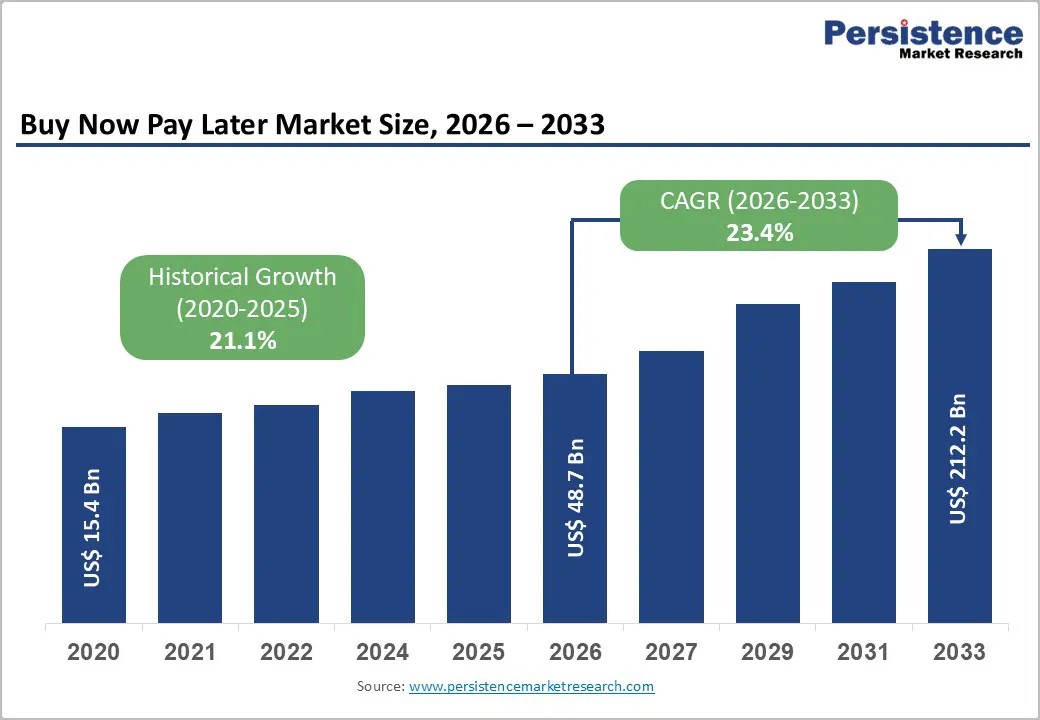
The buy now pay later market to grow from US$ 48.7 Bn in 2026 to US$ 212.2 Bn by 2033, registering a strong 23.4% CAGR during the forecast period
BRENTFORD, ENGLAND, UNITED KINGDOM, May 4, 2026 /EINPresswire.com/ -- The Buy Now Pay Later (BNPL) market is experiencing rapid growth, projected to rise from US$ 48.7 billion in 2026 to US$ 212.2 billion by 2033, at a CAGR of 23.4%. This expansion is driven by shifting consumer preferences toward flexible, interest-free payment options, especially among Millennials and Gen Z. The increasing integration of BNPL into e-commerce platforms and mobile apps is enhancing convenience and accelerating adoption across global markets.
Growth is further supported by rising e-commerce activity, financial inclusion initiatives, and the entry of major fintech and financial players. The online segment dominates with a 67% share, while North America leads regionally with around 31%. Asia Pacific is the fastest-growing market, fueled by digital adoption and expanding access to credit among underbanked populations.
𝐆𝐞𝐭 𝐚 𝐒𝐚𝐦𝐩𝐥𝐞 𝐏𝐃𝐅 𝐁𝐫𝐨𝐜𝐡𝐮𝐫𝐞 𝐨𝐟 𝐭𝐡𝐞 𝐑𝐞𝐩𝐨𝐫𝐭: https://www.persistencemarketresearch.com/samples/35349
Market Segmentation
The buy now pay later market is segmented based on channel, end-user, and enterprise size, each playing a crucial role in shaping the overall market dynamics. By channel, the market is divided into online and point-of-sale (POS) segments. The online segment holds the largest share due to BNPL’s seamless integration within e-commerce platforms, enabling real-time credit approvals and frictionless checkout experiences. POS-based BNPL is gaining momentum, especially in physical retail environments, as QR codes and tap-to-pay systems make installment payments more accessible in offline settings.
From an end-user perspective, the retail sector dominates the market, accounting for the majority of BNPL transactions. This dominance is driven by high adoption in consumer electronics, fashion, and home goods categories, where installment payments make high-value purchases more affordable. However, the automotive sector is emerging as the fastest-growing segment, as BNPL expands into financing vehicle accessories, EV charging infrastructure, and even used car purchases. Healthcare is also becoming a significant segment, with BNPL solutions enabling patients to manage medical expenses through flexible payment options.
In terms of enterprise size, large enterprises currently hold the largest market share due to their ability to integrate BNPL solutions into complex digital ecosystems and leverage extensive customer bases. However, small and medium-sized enterprises (SMEs) are rapidly adopting BNPL solutions, supported by plug-and-play integrations offered by platforms such as Shopify and WooCommerce. This trend is democratizing access to BNPL services, enabling smaller merchants to compete effectively in the digital marketplace.
𝐃𝐨 𝐘𝐨𝐮 𝐇𝐚𝐯𝐞 𝐀𝐧𝐲 𝐐𝐮𝐞𝐫𝐲 𝐎𝐫 𝐒𝐩𝐞𝐜𝐢𝐟𝐢𝐜 𝐑𝐞𝐪𝐮𝐢𝐫𝐞𝐦𝐞𝐧𝐭? 𝐑𝐞𝐪𝐮𝐞𝐬𝐭 𝐂𝐮𝐬𝐭𝐨𝐦𝐢𝐳𝐚𝐭𝐢𝐨𝐧 𝐨𝐟 𝐑𝐞𝐩𝐨𝐫𝐭: https://www.persistencemarketresearch.com/request-customization/35349
Regional Insights
The BNPL market exhibits strong regional variations, with North America leading in terms of market share and technological maturity. The United States, in particular, is a key driver of regional growth, supported by a well-established e-commerce ecosystem and high consumer adoption rates. The presence of major BNPL providers and continuous innovation in payment solutions further strengthens the region’s leadership position.
Europe represents the second-largest market, characterized by high consumer awareness and strong regulatory frameworks. Countries such as the United Kingdom, Germany, and Sweden are at the forefront of BNPL adoption, with established players driving innovation and market penetration. The region’s evolving regulatory environment is enhancing transparency and consumer protection, which is expected to support long-term growth.
Asia Pacific is the fastest-growing region, driven by rapid digitalization, increasing smartphone penetration, and a large underbanked population. Countries such as China and India are witnessing significant growth in BNPL adoption, supported by government initiatives promoting digital payments and financial inclusion. Southeast Asia is also emerging as a key growth area, with rising e-commerce activity and expanding fintech ecosystems.
Market Drivers
The growth of the BNPL market is primarily driven by the rapid expansion of global e-commerce and shifting consumer preferences toward flexible payment solutions. As online shopping continues to grow, BNPL services are becoming an integral part of the checkout process, offering consumers a convenient way to manage their finances. The increasing focus on financial inclusion is also a major driver, as BNPL platforms provide access to credit for underserved populations who may not qualify for traditional financial products. Additionally, advancements in technology, including artificial intelligence and data analytics, are enabling more accurate credit assessments and personalized payment solutions, further enhancing the appeal of BNPL services.
Market Restraints
Despite its strong growth prospects, the BNPL market faces several challenges. Rising concerns about consumer debt and default risk are significant issues, as increased adoption of BNPL services may lead to over-indebtedness among users. Regulatory scrutiny is also intensifying, with governments and financial authorities implementing stricter guidelines to ensure consumer protection and financial stability. These regulations may increase compliance costs for BNPL providers and limit their operational flexibility. Furthermore, competition from traditional financial institutions and emerging fintech players is intensifying, creating pressure on margins and market share.
Market Opportunities
The BNPL market offers numerous growth opportunities, particularly in emerging sectors such as automotive and healthcare. The integration of BNPL solutions into automotive financing is opening new revenue streams, enabling consumers to manage high-value purchases more effectively. Similarly, the adoption of BNPL in healthcare is addressing the growing demand for flexible payment options in medical services. The expansion of BNPL services into emerging markets, where large segments of the population lack access to traditional credit, presents a significant growth opportunity. Additionally, the development of innovative business models, such as B2B BNPL and embedded finance solutions, is expected to drive further market expansion.
𝐁𝐮𝐲 𝐍𝐨𝐰 𝐭𝐡𝐞 𝐃𝐞𝐭𝐚𝐢𝐥𝐞𝐝 𝐑𝐞𝐩𝐨𝐫𝐭: https://www.persistencemarketresearch.com/checkout/35349
Company Insights
• Afterpay Limited (Block, Inc.)
• Affirm, Inc.
• PayPal Holdings, Inc.
• Perpay Inc.
• Klarna Inc.
• Openpay
• Splitit Payments, Ltd.
• HSBC Group
• LatitudePay Financial Services
• Zip Co., Ltd.
• Slice
• OlaMoney Postpaid
• Simpl
• MobiKwik ZIP
• Amazon Pay Later
• Sezzle Inc.
Conclusion
The Buy Now Pay Later market is set for strong growth, driven by changing consumer preferences, advancing technology, and expanding digital commerce. As BNPL disrupts traditional credit models, its adoption across sectors like retail, automotive, and healthcare is expected to rise. Despite regulatory and credit risks, the market remains well-positioned as a key part of the future financial ecosystem.
Related Reports:
Executive Education Program Market
Pooja Gawai
Persistence Market Research
+1 646-878-6329
email us here
Visit us on social media:
LinkedIn
Instagram
Facebook
YouTube
X
Legal Disclaimer:
EIN Presswire provides this news content "as is" without warranty of any kind. We do not accept any responsibility or liability for the accuracy, content, images, videos, licenses, completeness, legality, or reliability of the information contained in this article. If you have any complaints or copyright issues related to this article, kindly contact the author above.
