

The latest news from the United Kingdom
Provided by AGP
Last-mile Delivery Software Market to Reach US$ 12.0 Billion by 2033 from US$ 7.6 Billion in 2026
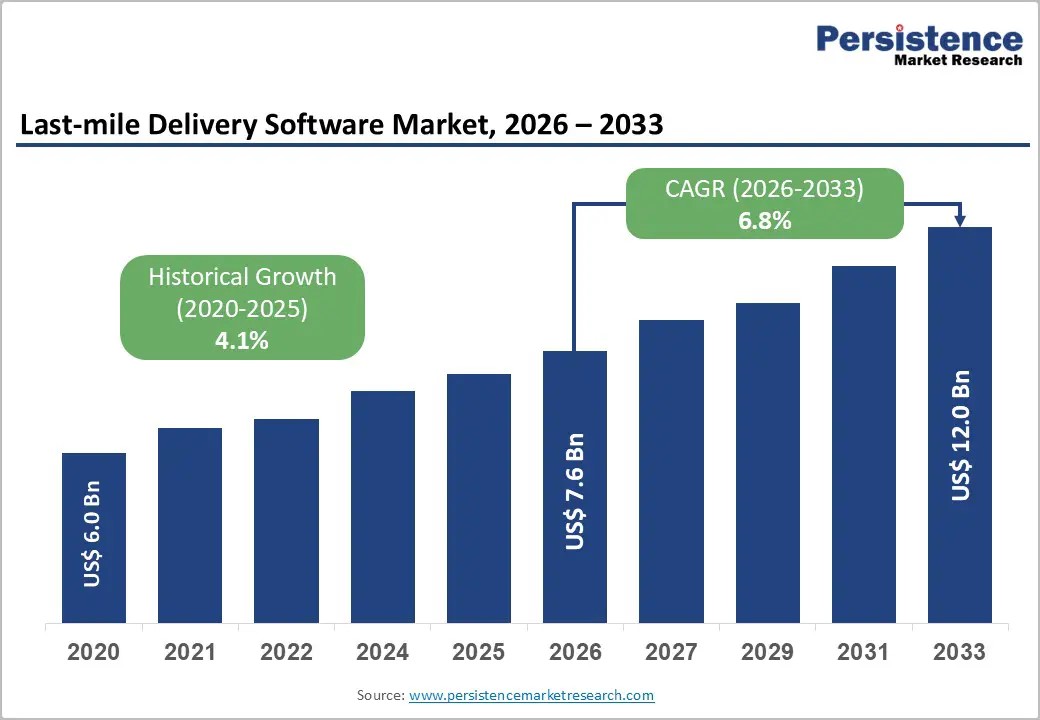
The global Last-mile Delivery Software Market is projected to grow from $7.6 Bn in 2026 to $12.0 Bn by 2033, at a CAGR of 6.8% during the forecast period
BRENTFORD, ENGLAND, UNITED KINGDOM, May 4, 2026 /EINPresswire.com/ -- The Last-mile Delivery Software Market is witnessing steady and sustained growth as logistics and e-commerce ecosystems continue to evolve toward faster, more efficient delivery models. The market is projected to grow from US$ 7.6 billion in 2026 to US$ 12.0 billion by 2033, expanding at a CAGR of 6.8% during the forecast period. This growth is closely tied to the exponential rise in online shopping, which has significantly increased parcel volumes and heightened customer expectations for rapid and reliable deliveries. Businesses are increasingly adopting last-mile delivery software to streamline route optimization, enable real-time tracking, and enhance delivery accuracy. These platforms are becoming essential tools for logistics providers seeking to reduce operational costs while improving customer satisfaction in a highly competitive environment.
Several key drivers are fueling the expansion of the last-mile delivery software market, including the rapid digital transformation of logistics operations, the integration of cloud-based technologies, and the rising need for automation and analytics. Among the leading segments, cloud-based software dominates with around 55% market share, primarily due to its scalability, flexibility, and cost efficiency compared to on-premise systems. In terms of application, the courier, express, and parcel segment is among the fastest-growing, driven by increasing demand for efficient delivery networks. Regionally, North America leads the market with a 41% share, supported by its mature e-commerce infrastructure and advanced logistics capabilities, while Asia Pacific is the fastest-growing region, propelled by urbanization, expanding internet penetration, and government-backed digital initiatives.
𝐆𝐞𝐭 𝐚 𝐒𝐚𝐦𝐩𝐥𝐞 𝐏𝐃𝐅 𝐁𝐫𝐨𝐜𝐡𝐮𝐫𝐞 𝐨𝐟 𝐭𝐡𝐞 𝐑𝐞𝐩𝐨𝐫𝐭: https://www.persistencemarketresearch.com/samples/33641
Market Segmentation
The last-mile delivery software market is segmented based on software type, deployment model, application, and end-user industries. In terms of software deployment, the market is primarily divided into cloud-based and on-premise solutions. Cloud-based software dominates the segment due to its ability to provide real-time access, seamless updates, and reduced infrastructure costs. These platforms are particularly beneficial for companies handling fluctuating delivery volumes, as they allow easy scalability without heavy capital investment. On-premise solutions, while still relevant for organizations with strict data control requirements, are gradually losing market share as businesses prioritize agility and cost-efficiency.
From an application perspective, the market includes e-commerce, courier and parcel services, food delivery, retail distribution, and logistics providers. The e-commerce segment holds the largest share, driven by the need to manage high order volumes and provide real-time delivery updates. Courier, express, and parcel services are also witnessing rapid growth, supported by increasing demand for fast and reliable delivery solutions. Additionally, industries such as healthcare and retail are adopting last-mile delivery software to ensure timely and secure delivery of critical goods, further expanding the market’s application scope.
Regional Insights
The last-mile delivery software market demonstrates strong regional diversity, with North America leading due to its advanced technological infrastructure and high adoption of digital logistics solutions. The region benefits from a well-established e-commerce ecosystem and the presence of major technology providers offering sophisticated delivery platforms. Continuous innovation in areas such as AI-driven routing and real-time analytics further strengthens North America’s leadership position.
Europe represents a mature and regulation-driven market, where sustainability and efficiency are key priorities. Logistics providers in countries such as Germany, the United Kingdom, and France are leveraging delivery software to optimize routes, reduce emissions, and comply with stringent environmental regulations. The region’s focus on smart-city initiatives and green logistics is driving demand for advanced delivery management solutions.
Asia Pacific is the fastest-growing region, fueled by rapid urbanization, increasing disposable incomes, and expanding e-commerce penetration. Countries such as China, India, and Japan are investing heavily in logistics infrastructure and digital technologies, creating significant opportunities for market growth. The region’s large population base and growing demand for fast deliveries make it a key growth engine for the global market.
𝐃𝐨 𝐘𝐨𝐮 𝐇𝐚𝐯𝐞 𝐀𝐧𝐲 𝐐𝐮𝐞𝐫𝐲 𝐎𝐫 𝐒𝐩𝐞𝐜𝐢𝐟𝐢𝐜 𝐑𝐞𝐪𝐮𝐢𝐫𝐞𝐦𝐞𝐧𝐭? 𝐑𝐞𝐪𝐮𝐞𝐬𝐭 𝐂𝐮𝐬𝐭𝐨𝐦𝐢𝐳𝐚𝐭𝐢𝐨𝐧 𝐨𝐟 𝐑𝐞𝐩𝐨𝐫𝐭: https://www.persistencemarketresearch.com/request-customization/33641
Market Drivers
The primary driver of the last-mile delivery software market is the rapid expansion of e-commerce, which has transformed consumer expectations around delivery speed and transparency. Companies are under constant pressure to provide same-day or next-day delivery, which requires advanced software solutions for route optimization, real-time tracking, and efficient resource allocation. The increasing adoption of cloud-based technologies and data analytics is also driving market growth, enabling logistics providers to make data-driven decisions and improve operational efficiency. Furthermore, the integration of delivery software with ERP and supply chain systems is enhancing end-to-end visibility, making it an indispensable component of modern logistics operations.
Market Restraints
Despite its growth potential, the market faces several challenges that could hinder adoption. High implementation and integration costs remain a significant barrier, particularly for small and medium-sized enterprises. Integrating new delivery software with existing systems often requires substantial investment in infrastructure and technical expertise. Additionally, concerns related to data security and privacy are becoming increasingly important as companies rely more on cloud-based solutions. Cybersecurity risks and compliance requirements add to the overall cost and complexity of adoption, slowing down market penetration in certain regions and industries.
Market Opportunities
The last-mile delivery software market offers significant opportunities, particularly in the integration of advanced technologies such as autonomous vehicles, drones, and robotics. These innovations are transforming delivery operations and creating demand for intelligent software platforms capable of managing complex logistics networks. The shift toward SaaS-based solutions also presents a major opportunity, as businesses seek flexible and cost-effective deployment models. Furthermore, the growing emphasis on sustainability is driving the adoption of software solutions that optimize routes and reduce carbon emissions, opening new avenues for growth in environmentally conscious markets.
𝐁𝐮𝐲 𝐍𝐨𝐰 𝐭𝐡𝐞 𝐃𝐞𝐭𝐚𝐢𝐥𝐞𝐝 𝐑𝐞𝐩𝐨𝐫𝐭: https://www.persistencemarketresearch.com/checkout/33641
Company Insights
• Oracle Corporation
• Kahnua
• FarEye
• Locus Robotics Corp.
• Descartes Systems Group
• Track-POD
• Google LLC
• Bringg Delivery Technologies
• Final Mile
• Amazon.com, Inc.
• Uber Technologies, Inc.
• Microsoft Corporation
• SAP SE
• LogiNext
• Zippykind
• Gloat
Related Reports:
Parking Management System Market
Micro Investing Platform Market
Persistence Market Research
Persistence Market Research Pvt Ltd
+1 646-878-6329
email us here
Visit us on social media:
LinkedIn
Instagram
Facebook
YouTube
Legal Disclaimer:
EIN Presswire provides this news content "as is" without warranty of any kind. We do not accept any responsibility or liability for the accuracy, content, images, videos, licenses, completeness, legality, or reliability of the information contained in this article. If you have any complaints or copyright issues related to this article, kindly contact the author above.
